Before you start
- Your download is a zip with two files. Double-click it to open it. Start with the one marked with examples to see how everything works, then use the blank one for your business.
- Open the file in Microsoft Excel. Using Google Sheets? Upload it to Google Drive, then open it with Google Sheets.
- Start on the Start Here tab. It has the same steps, right inside the file.
- The sample data is there so you can see how everything works. Type over it with your own when you're ready.
Here's how to set it up once, then spend a minute a week keeping your equipment out of the shop.
1List your equipment (about 5 minutes)
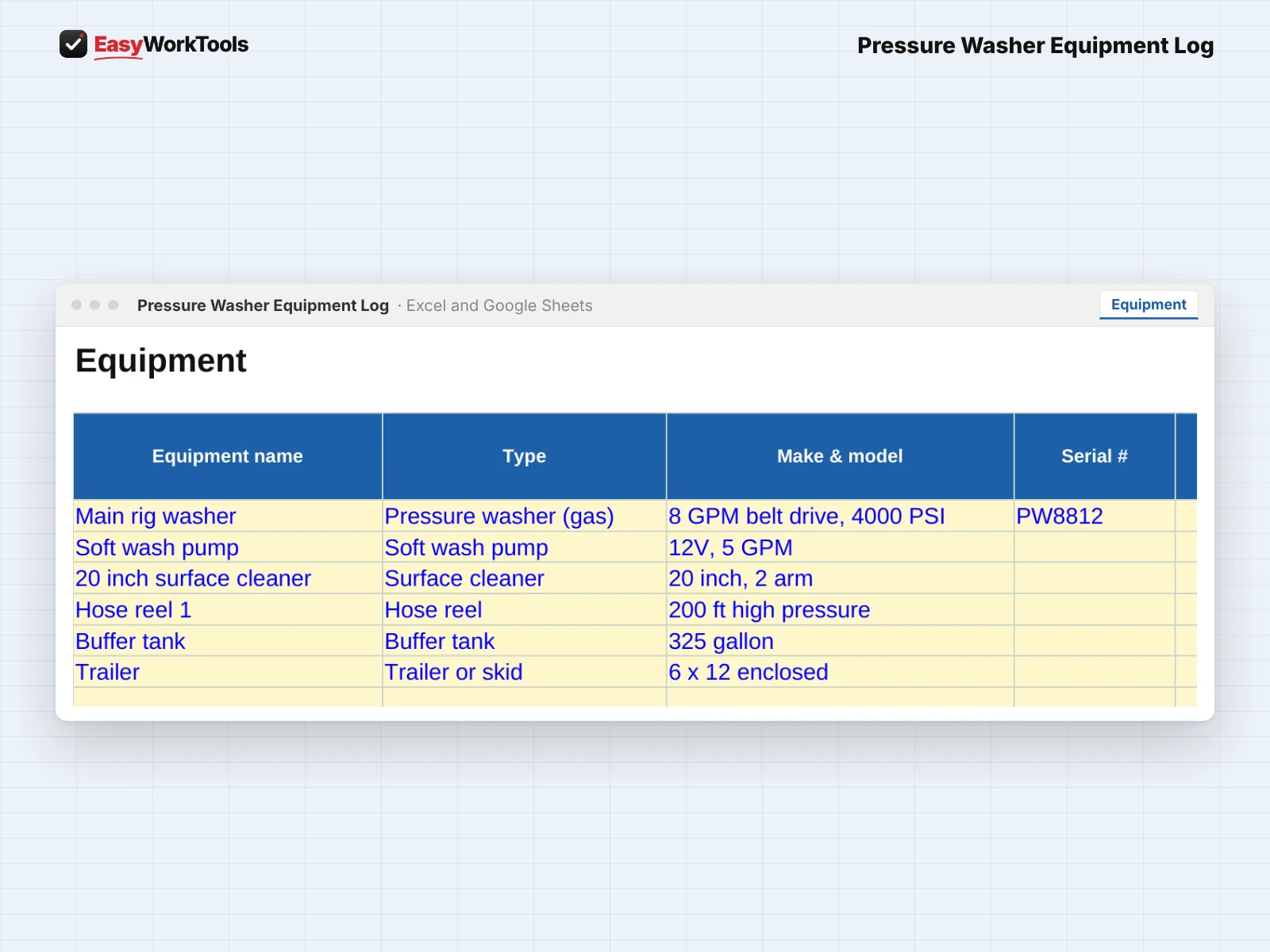
- Open Equipment and type over the examples with your own: pressure washer, soft wash pump, surface cleaners, hose reels, buffer tank, trailer, and truck.
- For each one, fill in the type, make and model, purchase date and price, and what it would cost to replace today. The replacement cost powers the repair-or-replace check.
- Add the warranty end date if it has one. The Dashboard warns you 60 days before it runs out, so you can get anything fixed while it's still covered.
- Add each machine's Rated PSI from its label or manual. That's what your pressure readings get compared against.
2Build the maintenance plan (about 5 minutes)
- Not sure how often to do things? Start with the Starter Intervals tab, then check your owner's manuals. Open Maintenance Plan. Add a line for each job a machine needs, like an oil change or sharpening blades.
- Set how often: every so many hours, every so many days, or both. Whichever comes first triggers the reminder.
- No hour meter on something? Leave hours blank and use days, like every 30 days.
- Done some of these jobs recently? Add them on the Log so the countdown starts from the right place.
3Log maintenance and repairs (30 seconds each)
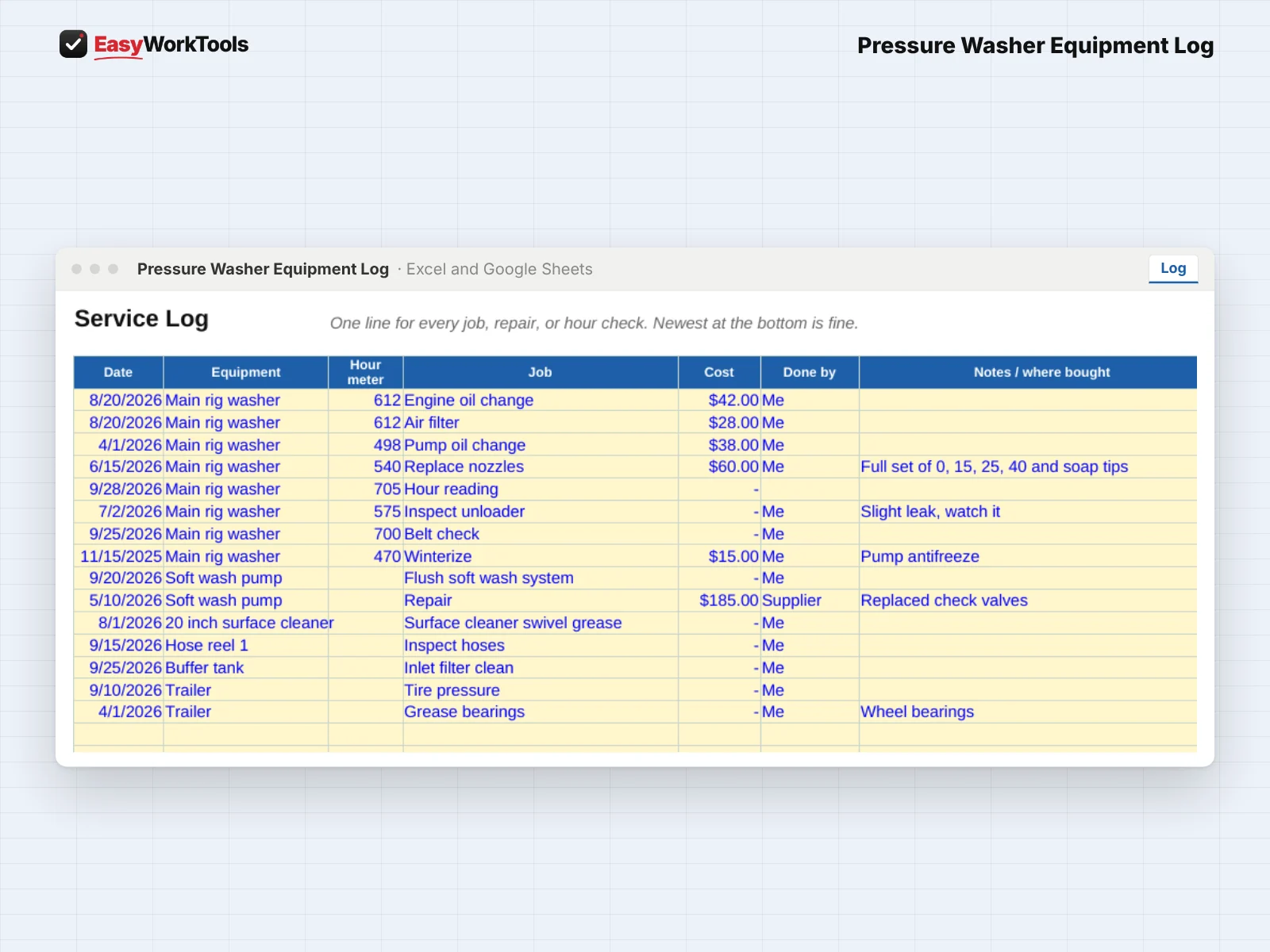
- Open Log and add one line whenever you do maintenance, make a repair, or just check the hour meter.
- Fill in the date, the machine, the hour meter reading, the job, and the cost. Note where you bought parts. It's handy for warranty claims and taxes.
- Log an Hour reading every week or two, even with no work done. It keeps the hours countdown accurate.
- Once a week, check your pressure with a gauge and type it in PSI reading. A drop is your earliest warning that a pump, unloader, or nozzle is going.
- If a machine was out of service, type the days in Days out of service. The Dashboard shows what that downtime cost you.
4Check what's due (every week)
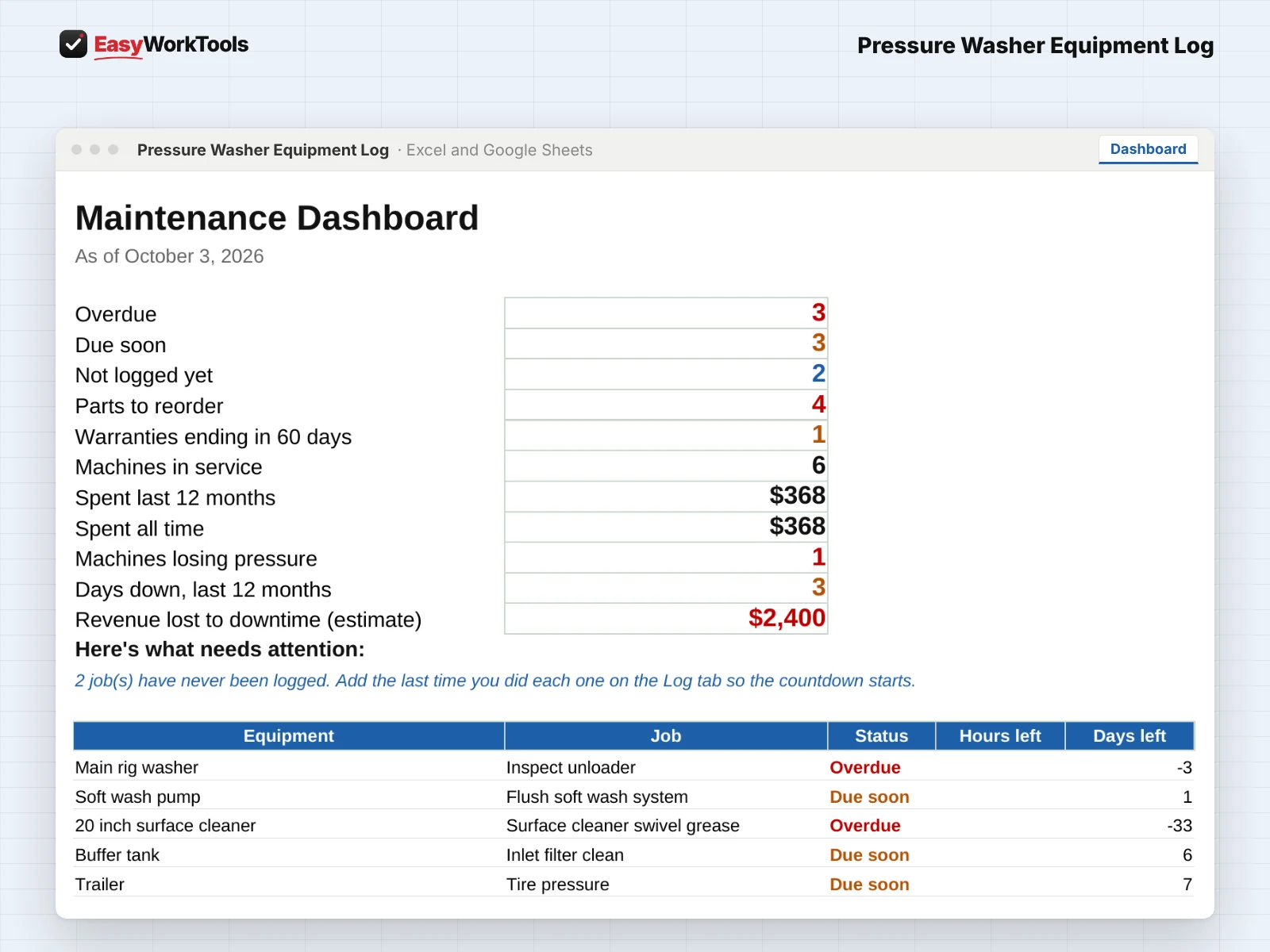
- Open the Dashboard. Red means overdue, orange means due soon.
- The list under Here's what needs attention shows each job with hours and days left.
- The Dashboard also counts parts to reorder, warranties ending soon, and what you've spent this year and all time.
- Machines losing pressure are counted too, along with days down and revenue lost to downtime.
5Keep parts on hand
- Open Parts and list each machine's filters, blades, belts, plugs, nozzles, o-ring kits, and swivel kits, with part numbers and where you buy them.
- Set how many you have and when to reorder. The status turns to Reorder when you're running low.
6Use the pre-job checklist
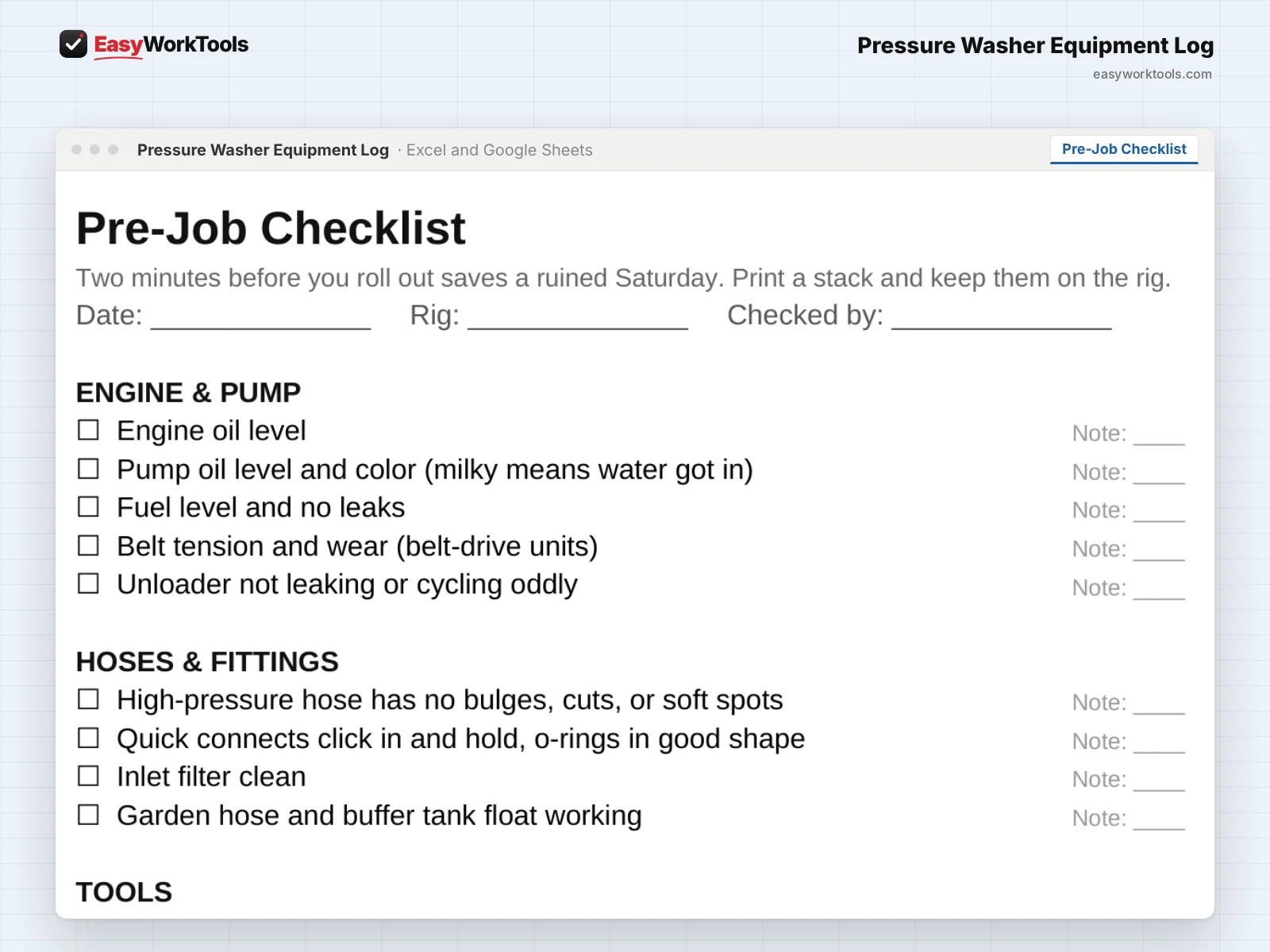
- Open Pre-Job Checklist and print a stack.
- Keep it on the rig. Two minutes of checks before you roll out saves a ruined Saturday.
What the messages mean
The tool watches your numbers and tells you in plain words when something needs a look. Here's every message you might see.
What to do: Type the hour meter number on that Log line.
What to do: Check the date. Usually it's the wrong year or month.
What to do: Add the date the work was done.
What to do: Add the last time you did it on the Log, even a rough date.
What to do: Look at the Check column on Equipment and decide whether to keep repairing it or replace it.
What to do: Nothing to do.
Using Google Sheets or your phone
- To use Google Sheets, upload the file to Google Drive, then right-click it and choose Open with, then Google Sheets.
- Dropdowns, colors, and every calculation work the same in Google Sheets.
- On a phone, the Google Sheets and Excel apps work for quick changes. For setup and printing, a computer is easier.
- Want to start fresh? Type over the yellow example cells. Don't delete rows, since other tabs may be reading them.
Common questions
My trimmer doesn't have an hour meter. Does that work?
Yes. Leave hours blank and set its jobs by days instead.
Can I add my own jobs and equipment types?
Yes. The lists are on the Settings tab, and you can edit or add to them.
Quick reference from the Start Here tab
Welcome
A pump that fails on a Saturday house wash costs you the job, the day, and maybe the customer. This log tells you what's due before it breaks, from pump oil to worn nozzles, tracks every dollar you spend on each machine, and shows when it's time to replace instead of rebuild.
Setup (About 10 Minutes)
Open 'Equipment'. List every machine and major part: pressure washer, soft wash pump, surface cleaners, hose reels, buffer tank, trailer, truck.
Not sure how often to do things? Check the Starter Intervals tab, then your owner's manuals.
Open 'Maintenance Plan'. For each one, list the jobs it needs and how often, by engine hours, by days, or both. Your owner's manuals have the right numbers.
If you've done some of those jobs recently, add them on the 'Log' so the countdown starts from the right place.
Every Week
Add a line on 'Log' whenever you do maintenance, make a repair, or just check the hour meter.
Glance at 'Dashboard'. Red means overdue, orange means due soon.
Once a week, check your pressure with a gauge and log the PSI. A drop is your early warning.
Print the Pre-Job Checklist and keep it on the rig.
Handy Tips
Nozzles wear out and quietly drop your pressure. If jobs start taking longer, check your nozzles before blaming the pump.
Change pump oil on schedule. It's cheap, and pumps are not.
Winterize before the first freeze. A frozen pump or unloader can crack overnight.
No hour meter on a part, like a surface cleaner or hose? Leave hours blank and use days instead.
Fill in the Parts tab with your nozzle sizes, o-ring kits, and swivel kits. No more guessing at the supply shop.
Using Google Sheets? Upload this file to Google Drive and open it with Google Sheets. Everything works the same.
Your License
This file is licensed to one business, including everyone who works there. Please don't share, resell or post it online.
© 2026 EasyWorkTools. All rights reserved. easyworktools.com
Every tab
This file has 9 tabs, in this order:
- Start Here
- Dashboard
- Equipment
- Maintenance Plan
- Log
- Parts
- Pre-Job Checklist
- Starter Intervals
- Settings